Tips for Photographing Star Trails

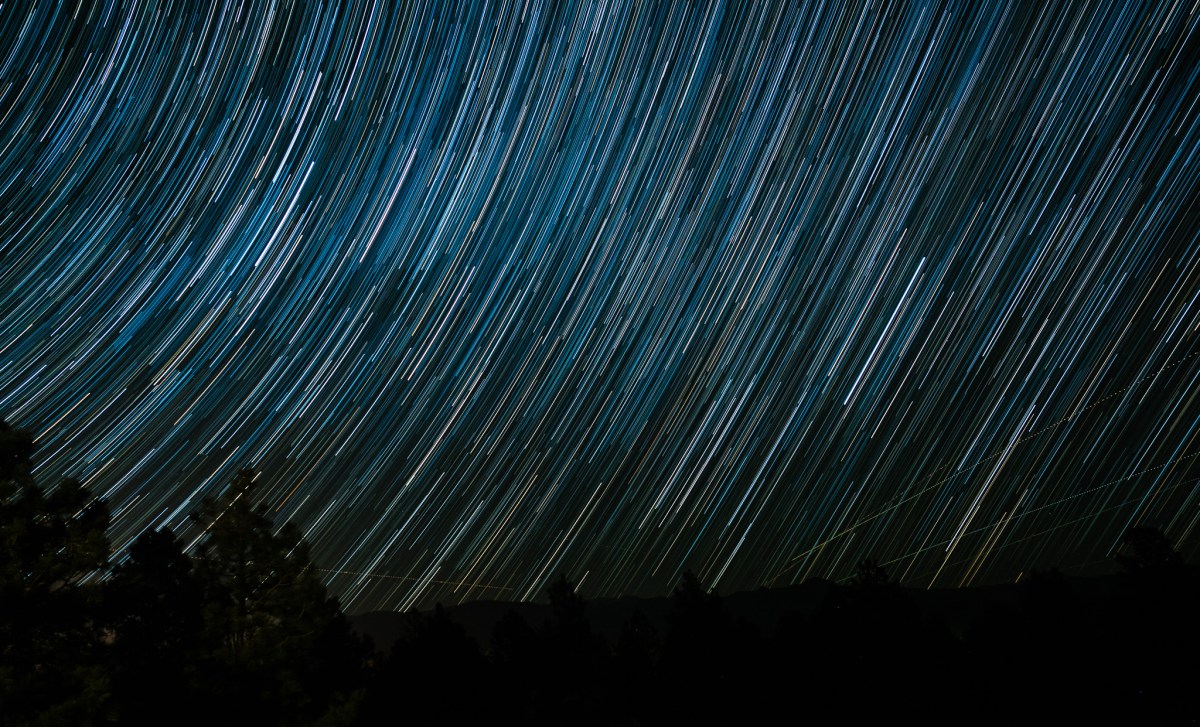
One of the topics I did not have time to discuss during last week’s presentation on photographing the Milky Way was making images of star trails. Ian Johnson has published some good tips and techniques for star trail photography over at Digital-Photography-School.com . It’s well worth a read if you are interested in this type of photography. Johnson discusses the basics of star trails, as well as composition, processing, light painting, and the effects of focal length and exposure times. It’s clear that this is an approach that is ripe for lots of experimentation and creativity.

I’ve learned one trick that works well for star trails if you don’t have an intervalometer, or like me, you are too lazy to use the one built into your camera. You do still need a cable release, though. Once you have your camera set up to capture the scene you want, set the camera’s shutter speed to the longest possible, without going into bulb mode. On my Nikon, this is 30 sec. Then, set the camera for high-speed continuous shooting. This is the mode that allows you to press the shutter button down and take photo after photo until you let up. Start the star trail sequence by locking the cable release to “on”. In this mode, the camera will take a 30 sec exposure, then another, and repeat until you unlock the cable release. The camera will fire away, shot after shot, until you stop it (or the battery dies). Using a wide angle lens, you probably want to let it go at least half an hour, and longer is often better. With a 50 mm or longer lens, a shorter time will give you good trails. Johnson walks you through the steps for combining the photos as layers, using the “lighten” blend mode in Adobe Photoshop. This will work in any software that uses layers and has the proper blend mode. I use a dedicated app called StarStax, which has several features such as gap filling (for the brief time between sequential images) and the ability to save out intermediate steps to create a time-lapse movie effect. StarStaX is free, but if you like it, the software’s author would appreciate some money for beer or coffee as a donation.

Another consideration is that you can control the apparent density of trails using the ISO setting on your camera. ISO 1000, for example, will give you many trails close together. ISO’s of 200 to 400 would give you fewer trails, mostly from the brighter stars. It’s another way to control the look of your image.

As with all nightscapes, knowing a little about the stars, planning for a foreground, and using some creativity will help you make great images.
Photography in the Dark, May 9

The Pagosa Springs Photography Club will meet on Wednesday, May 9, at the Community United Methodist Church, 434 Lewis St. Join us for socializing at 6 p.m., followed by a brief business meeting at 6:30 p.m. before our program. Experienced photographers and those just starting out are welcome to attend.

Our speaker this month will be Andy Butler. He will discuss techniques for night sky photography, particularly creating images of the Milky Way. Topics will include techniques for planning night landscapes featuring the Milky Way, photographing these scenes in single and multiple images, and processing the final images. 

Photography Club members may bring up to 10 images on  a flash drive to share and discuss with the group.

Photography enthusiasts at all levels of ability are invited to attend Club meetings at no charge for the first meeting. If interested, you are invited to join for annual dues of $25 for individuals, or $35 for a family membership

If you have questions about the Photography Club, please visit our website at pagosaspringsphotoclub.org

Organizing with the Lightroom Catalog

Egret Preening
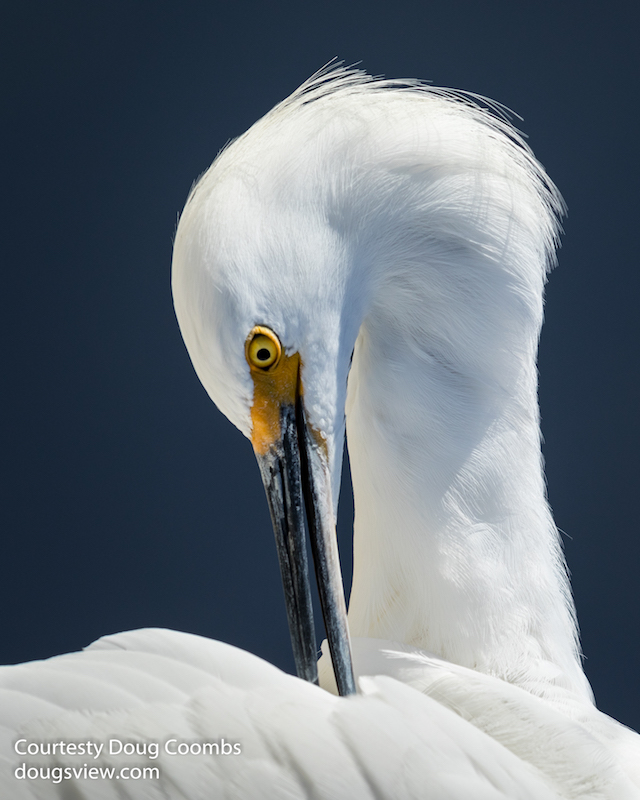
Egret Preening, © Doug Coombs, dougsview.com

The Pagosa Springs Photography Club will meet on Wednesday, April 11, at the Community United Methodist Church, 434 Lewis St. Join us for socializing at 6 p.m., followed by a brief business meeting at 6:30 p.m. before our program. Long time photographers and those just starting out are welcome to attend.

Our speaker this month will be Los Alamos and Pagosa Springs based photographer Doug Coombs. Doug will present an overview of using the Adobe Lightroom catalog module. He will demonstrate exporting from the catalog to various file formats such as .jpg, .tiff, .psd and .dng. Additionally he will show how to export from initial catalogs made on a notebook computer, often while in the field, to a master catalog on an external drive. Finally, he will show a free Windows backup utility called SyncToy that is very useful for synchronizing backups across multiple internal and/or external drives in order to gain redundant backup copies of your photos. Doug is primarily a wildlife and landscape photographer. Doug is active in the Los Alamos Adobe Users Group, and the Los Alamos Photography Club. His images may be viewed on his website, http://www.dougsview.com. 

Photo Club members may bring up to 10 images on  a flash drive to share with the group.

For questions or information about the Photography Club, please use the contact form on our website at: https://pagosaspringsphotoclub.org/about/contact/. 

Upcoming Photography Club Activities

Chaco Phenomenon
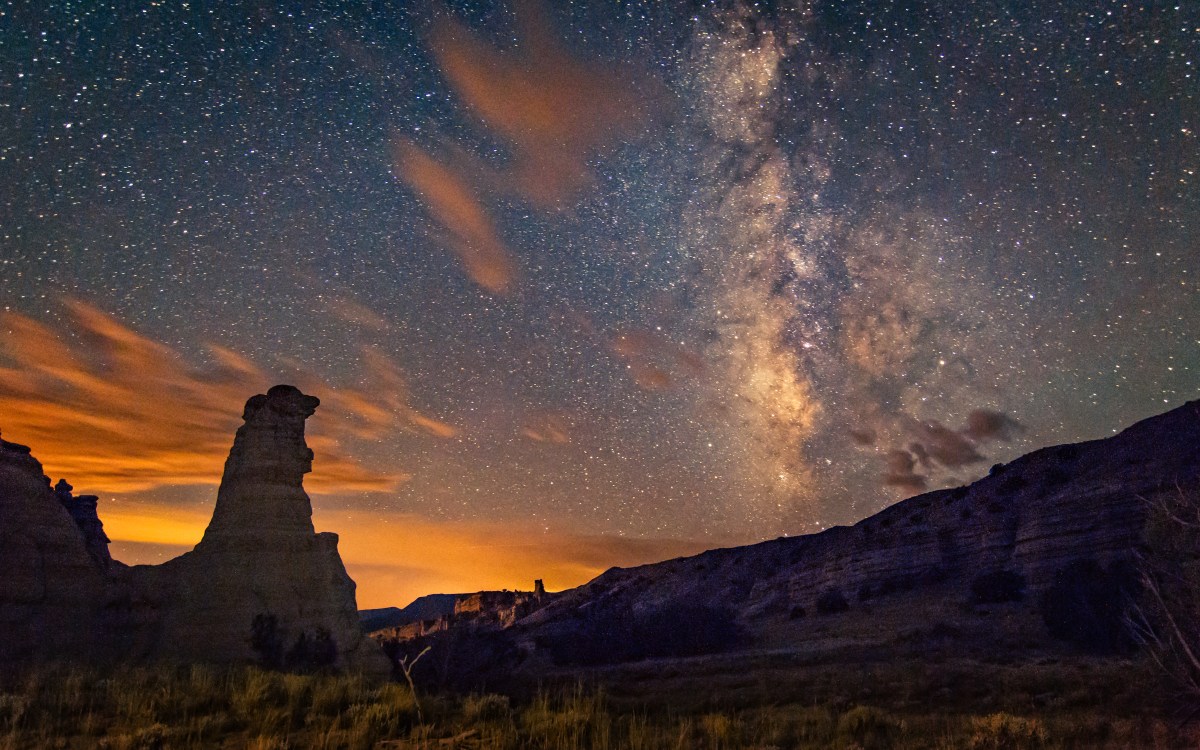
Milky Way above Chaco Canyon © Andy Butler

Here are some of the activities we are planning this spring and summer for the Photography Club:

April 11: For our monthly meeting, Doug Coombs (http://www.dougsview.com/) will give us a presentation on tips for using Adobe Lightroom’s library module to import and organize photos on your computer.

May 9: Andy Butler will discuss techniques for night sky photography, particularly Milky Way photography. Later in the season, we plan to have a club outing to do this type of photography.

June 13: Randy McCormick will give a program “Sea to Summit—we’re all connected,” a photographic journey to the western Everglades on the southwest coast of Florida. If we look closely, we can see that many of the fundamental characteristics that underlie intact natural ecosystems are similar and can be experienced everywhere, whether in Florida or along the Continental Divide

Watch for our upcoming digital photo contest. We will officially announce the contest and rules by early summer, with submission around the first of August and display of the winners and other entrees at our September meeting.

Outings that we are working on include a photo shoot of the Cumbres & Toltec rail yard, a trip to the ghost town of Summitville and one or more summer outings for mountain scenery and wildflowers. Ideas for outings are always welcome!

Creating Close Encounters, March 14

Eight-spotted skimmer along a lake shore
An Eight-spotted Skimmer perched along the edge of Lake Forest, photo by Andy Butler.

The Pagosa Springs Photography Club will meet on Wednesday, March 14, at the Community United Methodist Church, 434 Lewis St. Join us for socializing at 6 p.m., followed by a brief business meeting at 6:30 p.m. before our program. Both experienced photographers and those just starting out are welcome to attend.

This month’s program will be “Visualizing an Unseen World: Close-up and Macro Photography.” It will be presented by Club president Andy Butler.  Photographing the “unseen” small details of our world can add an extra dimension to your photography, and is something that can be done with a variety of cameras. Andy will discuss close-up equipment, technique & depth of field, lighting, and composition. Examples shown will include primarily flowers, butterflies and dragonflies.

Members may bring up to 10 images on  a flash drive to share with the group. Those of you who do close-up photography are encouraged to bring examples of your images for discussion.

For questions or information about the Photography Club, please visit our website, pagosaspringsphotoclub.org/news/.

Feb 14: Spain & Portugal’s Greatest Hits

Flemenco (left), Equestrian School (right)
Flamenco, Granada, Spain (left); Royal Equestrian School, Jerez, Spain (right), photograph ©Robert B. Green

The Pagosa Springs Photography Club will meet on Wednesday, February 14, at the Community United Methodist Church, 434 Lewis St. Join us for socializing at 6 p.m., followed by a brief business meeting at 6:30 p.m. before our program. Long time photographers and those just starting out are welcome to attend.

Our program this month will be an encore presentation by Bob Green. In the fall of 2016 and 2017, Bob and his wife spent a month total traveling through Spain and Portugal: beginning in Barcelona, traveling through northern Spain via the Pyrenees and along the Way of St. James to Santiago de Compostela, then south to Porto and Lisbon. From there, they proceeded east to Evora, Portugal and Seville, Spain. Then, they traveled south to Gibraltar (a British territory) and finally through Granada, Cordoba and Toledo, finishing their journey in Madrid, in the heart of Spain.

Bob took over 3000 photos on these trips. His talk will examine six widely-accepted principles whose exercise will lead to noteworthy, compelling images. “Spain & Portugal: Greatest Hits” will include the top 50 photos from his travels and he will point out how various “rules” come into play as we view the images.

Members may bring up to 10 images on a flash drive to share with the club after the presentation. Given the program date, members are encouraged to include some images which speak to the theme of “romance”.