April Dark Skies

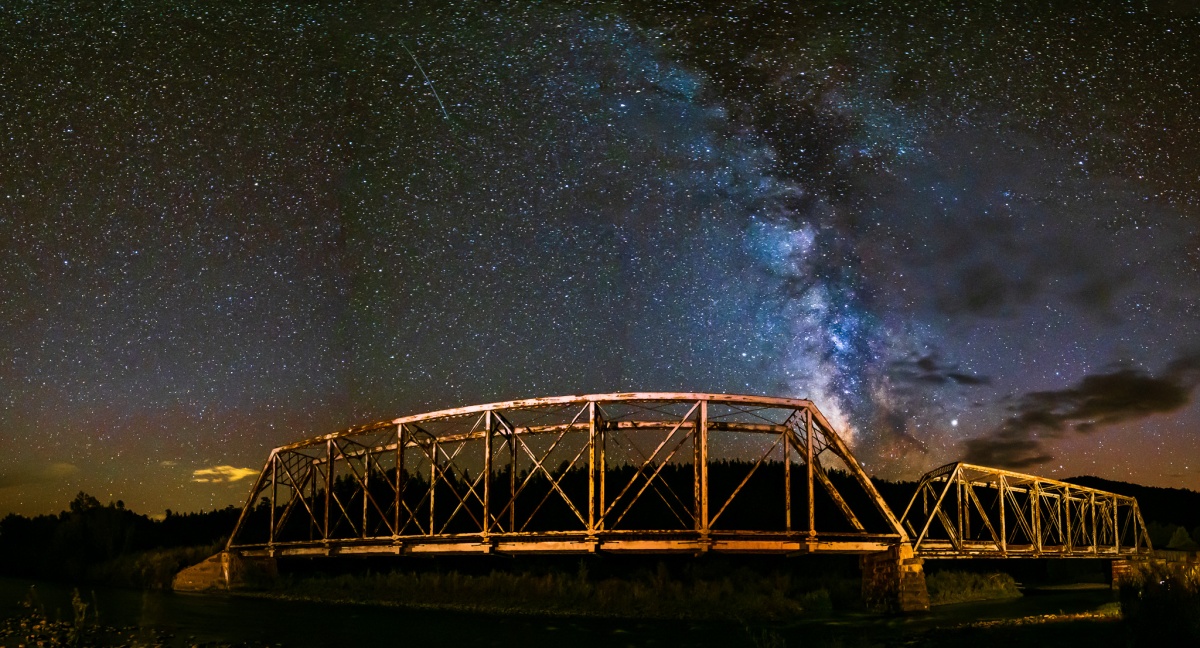
Spring in the northern hemisphere is the beginning of Milky Way season, when the Galactic Center is above the horizon at night. Although the Milky Way can be photographed anytime of the year when the sky is dark enough, the region around the Galactic Center contains the most detail and so is more photogenic. Spring is also the time when the Milky Way can be seen as a full arch, low enough in the horizon to photograph with some landscape visible. Fortunately, many of us in the Pagosa Springs area live where skies are dark enough that we can photograph the Milky Way without traveling, so it could be a good subject while we are “staying at home”.

In April 2020, opportunities to photograph the Milky Way from Pagosa Springs, without interference from the Moon, begin on the 14th and last into the first couple of days of May. The new moon will be April 22, so the best dark sky conditions and longest time for viewing the Milky Way would be a couple of days on either side of the 22nd. During this period, you could photograph the Milky Way from around 1 a.m. until shortly before dawn, about 4:45 a.m.. For details, see any of a number of apps, such as PhotoPills, Sun Surveyor, or The Photographer’s Ephemeris, desktop programs such as Stellarium. 

Night sky photography isn’t just about the Milky Way. A classic method of photographing the night sky is to make very long exposures which show the motion of the stars as star trails. As with any night scape photography, the best images will also have a strong foreground, perhaps illuminated by the waning moon, low level LED light panels, or by light painting with a flashlight. For tips and references on start trail photography, see this post. 

Also coming up next week is the Lyrid meteor shower, which should be active beginning April 19, and  peak in the predawn hours of April 22 this year. However, you should be able to see some activity of the Lyrid any dark night from April 10 through 23, with up to 10-15 meteors per hour. The Lyrid shower occurs every spring, and if the skies are dark and clear, it can be one of the best meteor showers of the year. Fortunately, with the new moon on the 22nd, there should be excellent viewing of the Lyrids this year. To photograph the Lyrids, all you need is a clear, dark sky, wide angle lens, camera and intervalometer (built in or external) and lots of patience. For an excellent introduction to techniques for photographing meteor showers, see this article by Glenn Randall.

If you are sheltering in place, don’t live in a dark sky area, or just are not into going outside to photograph the Milky Way in the wee hours, here is an indoor activity.  The week of April 19 to 26 has been designated as International Dark Sky Week by the International Dark Sky Association, with the goal of reconnecting people around the world with our night sky. On their website, https://idsw.darksky.org , you can find a variety of virtual presentations that you can watch each day of that week. Topics include the relationship between humans and the night sky through history, basic astronomy, and art and conservation. Some of the presentations are stories about the night sky, appropriate for kids. You can also follow these and other presentations of the IDSA on their Youtube channel.

Happy star gazing!
April Meeting Canceled

Oh, the lovely fickleness of an April day!  —  W. H. Gibson

Because of State of Colorado and local health orders related to the Covid-19 pandemic, the Pagosa Springs Photography Club will not be holding our regular monthly meeting on April 8. We will also not be doing any in-person group outings during April. 

We encourage our members to continue to practice their craft and develop their photographic skills. There are plenty of photographic opportunities near, and in, your homes. Just use your imagination, and maintain appropriate social distance. This is also a great time to make sure your backups are up to date, to make a few prints, or to develop your post-processing skills. Learn something new and different. Several on-line learning sources have made their content free for the time being. These include:

Professional Photographers of America, (https://www.ppa.com/education-unlocked)

KelbyOne: (https://kelbyone.com/free)

Nikon School: (https://www.nikonevents.com/us/live/nikon-school-online/)

Continuing to be creative and engaged can be a huge emotional boost while you are staying home to stay healthy. Also, consider taking part in our on-line Photography Club Shutter Therapy challenges. The first week (through April 6) is on the theme “Spring.” To view or participate, check out our Facebook page at https://www.facebook.com/PagosaPhotoClub/ and view the photos in the comments of the March 29 post on Spring Shutter Therapy. 

Spring Photography

The beautiful spring came; and when Nature resumes her loveliness, the human soul is apt to revive also. –Harriet Ann Jacobs

I was surprised to note that the vernal equinox, the official start of spring in the northern hemisphere, comes on March 19 this year (In the USA). That’s early. Typically the first day of spring is the 20th or 21st of March. Indeed, according to The Old Farmer’s Almanac, this is the earliest spring equinox since 1896!  It turns out that this is due to quirks in our calendar system related to leap year (and leap century). And as a result of these quirks, spring will begin on March 19 every leap year this century. 

Given how early the vernal equinox is this year, perhaps I should not have been surprised (but was, at least a little) to have 7 inches of new snow on the first day of spring. That’s the heaviest single snow fall we’ve had, at our house, during this somewhat dry winter! It was just a little reminder that here in the Rocky Mountains,  spring doesn’t always pay strict attention to the calendar. Still, this is a good time for a post about spring photography. 

Although we have many great opportunities for landscape and nature photography in the winter here in the southern Rockies, there is no question that the new life associated with Spring makes it a joy to photograph this time of year. The grass is green, one of the most evocative colors for humans. Birds and mammals are migrating. Flowers are beginning to bloom. And, given our altered way of life in the era of COVID-19, it is fortunate that there is still a lot of photography that we can do locally, often in our own backyards, this time of year

In a recent video, Photo Tom explores 9 tips and ideas for spring landscape photography. It’s worth watching to revisit some ideas for the season. One that I think is big, is to look for the transition time between seasons. The snow this week may present opportunities for photographing the contrast of flowers, for example, in snow. Other ideas include taking advantage of the bright green of spring foliage, weather patterns, and foggy mornings. Check the forecasts for the day after storms move through. Cool mornings after a storm will likely produce fog in the valleys, especially around our hot springs. Fog creates opportunities for interesting, moody photos. If you are on a ridge above valley fog, you may have a dramatic sunrise. Later in spring, as the snow melts from the high country, waterfalls and streams will be flowing strongly, making for excellent photographic opportunities. For more ideas about spring subjects, as well as composition and lighting tips to take advantage of them, check out this post by Larry Price.

Of course, one of the highlights of spring are the blooming flowers.  Anne Belmont is a creative flower photographer, and shares a number of good ideas for unique, artistic flower photos in a two part series. These articles are full of ideas, including  seeing flowers uniquely, and suggestions for creative aperture and composition  When thinking about flowers, as well as other spring subjects such as butterflies, you’ll want to think Macro. Macro photography is easily done in your own back yard (or even inside) and can be very rewarding in terms of training your eye to see textures and patterns Lee Hoy has some good suggestions for getting started .  

There are plenty of subjects worthy of a photographer’s attention in the spring. So take advantage of the season to practice your photography, but be safe about it!

Photo Club Moab Outing

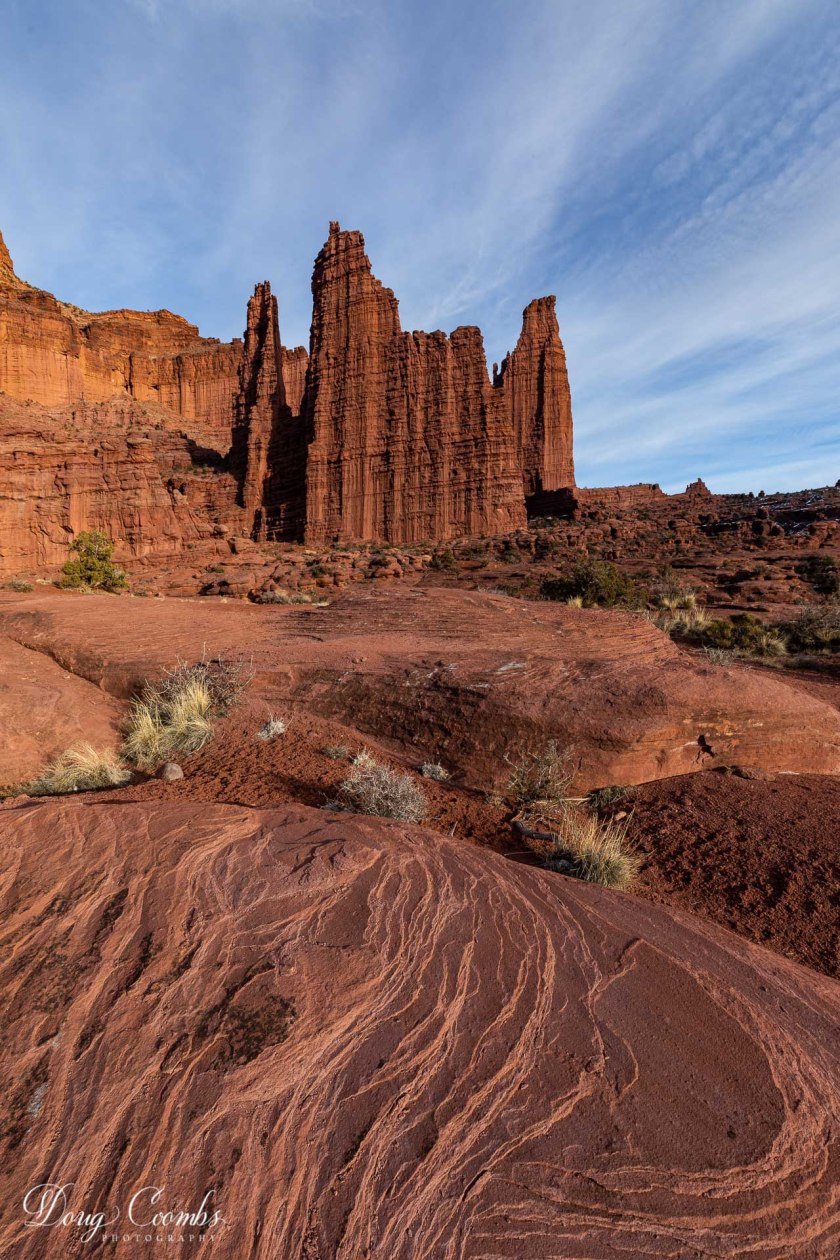
In mid-February, fourteen Photography Club members spent a few days in the Moab area, enjoying the magnificent red rock landscape. The group photographed in Arches National Park and  other nearby sites. We were lucky to have fair weather (though chilly mornings) and good light for most of our photo shoots. The trip was a really fun four days in a fantastically photogenic area. Here is a gallery of images from several Club members who were on  the trip. (Click on any image to view the photos full screen.)

March Club Meeting: Black and White

Teton Cloudcap
Teton Cloudcap, Grand Teton National Park, Wyoming, © Dave Anderson

The March 11, 2020 meeting of the Pagosa Springs Photography Club will be held at 6 p.m., at The Community United Methodist Church, 434 Lewis Street. Our speaker this month will be Club member Dave Anderson, who will give a presentation on  Black and White Photography in the Digital Age.  

Black & white photography can be useful for emphasizing textures, shapes and contrasts in images, for creating more abstract views of a scene, creating dramatic sky or sky-sun combinations in images, and for architectural and fine art photography. The presentation will discuss different methods of creating black and white photographs, and the use of digital filters and presets to produce black & white images in Photoshop and Lightroom post-processing software, with examples comparing color and black & white versions of the same image.

Dave Anderson has a Ph.D. in Chemistry and worked before retirement as a research scientist on malaria, multi-drug resistant bacteria, disease biomarker discovery, drug target identification and other areas. His photographic interests include landscape and nature photography and occasionally urban and abstract photography.

Club members are encouraged to bring up to five photos on a thumb drive to share with the group after the presentation, if time permits. If you have some black & white images of your own, this would be a great month to bring them! (Please note the new limit of five photos, designed to allow more time to appreciate and discuss the images.)

The Pagosa Springs Photography Club promotes educational, social and fun interactions between all who enjoy making and viewing great photography.  The club sponsors educational programs and outings to help photographers hone their skills. Membership is just $25/calendar year for individuals and $35 for families. Non-members are invited to attend a meeting to learn more about the club. For membership information visit our website at https://pagosaspringsphotoclub.org/about/ .

Creating a Digital Signature

_N5A0557Bsm
Big Horn Ram in Yellowstone National Park, © Doug Coombs

The February 12 meeting of the Pagosa Springs Photography Club will be held at 6 p.m., at The Community United Methodist Church, 434 Lewis Street. Our speaker will be Doug Coombs, on Creating a signature for digital artwork.  

Join us for socializing at 6 p.m., followed by a brief business meeting and presentation at 6:30 p.m. Club members are encouraged to bring up to five photos on a thumb drive to share with the group after the presentation, if time permits.

Doug will show how to create a signature for your digitally produced photographs and artwork using Photoshop. Such a signature can be stored as a .png image to be used from any post processing tool including Lightroom and Photoshop. He will discuss downloading and adding additional fonts to Photoshop, concepts related to font customization, and will demonstrate in real-time creation of a signature and how to use it in Lightroom and Photoshop.

Doug is the chair and co-founder of the Los Alamos Adobe Users Group in New Mexico and a former chair of the Los Alamos Photography Club. He has been doing photography since high school, worked as a photographer and dark room tech in college, and fell in love with digital photography in 2003. Doug is primarily a landscape and nature photographer, with an affinity for birds and wildlife. He splits his time between Los Alamos, Pagosa Springs, and a generous amount of travel to various photogenic destinations.

The Pagosa Springs Photography Club promotes educational, social and fun interactions between all who enjoy making and viewing great photography.  The club sponsors educational programs and outings to help photographers hone their skills. Membership is just $25/calendar year for individuals and $35 for families. Non-members are invited to attend a meeting to learn more about the club. For membership information visit our website at https://pagosaspringsphotoclub.org/about/ .