This month’s Photography Club meeting will be on Wednesday, July 14 at 6:30 PM, MDT. Our featured speaker this month is Doug Coombs. Doug’s presentation will be Lightroom Catalog—Part II. In his May presentation, Doug described the basics of Adobe Lightroom’s catalog, including how to create a catalog, how to import images to a catalog, the relationship and location of the catalog and your images, useful settings, and backing up the catalog.
In this second part, Doug will go cover the layout of the Library module in Lightroom, and will discuss some of the tools for organizing images, including using the Filter, Toolbar and Filmstrip. He will discuss and demonstrate using collections, keywords, and built-in metadata like EXIF to efficiently organize and search for images in the Lightroom Catalog.
Club members will receive an email with the Zoom link for this presentation. Others who are interested in watching may contact Andy Butler at abutler@mac.com for the link.
Doug Coombs is a co-founder of the Los Alamos Adobe Users Group in New Mexico and former chair of the Los Alamos Photography Club. Doug is primarily a landscape and nature photographer, and is well-known for his bird and nightscape photographs. Examples of Doug’s photography can be found on his website, dougsview.com. He splits his time between Los Alamos, Pagosa Springs, and a generous amount of travel to photogenic destinations.
The Pagosa Springs Photography Club promotes educational, social and fun interactions between all who enjoy making and viewing great photography. The club sponsors educational programs and outings to help photographers hone their skills. Membership is just $25/calendar year for individuals and $35 for families. Non-members are invited to attend a meeting to learn more about the club. For membership information visit our website at https://pagosaspringsphotoclub.org/about/ .
The June meeting of the Pagosa Springs Photography Club will be held on June 9 at 6:30 PM (Mountain Daylight Time), via Zoom video conference. Our speaker will be Dave Anderson, who will discuss Focus Stacking and Image Sharpness.
In Dave’s presentation, he will discuss the use of focus stacking to maximize sharpness and depth of field in both macro and landscape photography. Focus stacking is the process of taking serial images of an object or scene, with the plane of focus moving through the subject, combined to give an increased depth of field. Discussion will include several factors important for perceived image sharpness such as depth of field, diffraction, lens quality, and visual acuity. A number of software options for focus stacking will be presented, and the process of stacking in Photoshop will be described. Dave will provide examples of stacked images that succeeded and failed, stacking with unintended consequences, and tips for successful focus stacking.
Club members will receive an email with the Zoom link. Others who are interested in taking part may contact Andy Butler at abutler@mac.com for the link. Club members may submit up to five images to share and discuss following the presentation.
The Pagosa Springs Photography Club promotes educational, social and fun interactions between all who enjoy making and viewing great photography. The club sponsors educational programs and outings to help photographers hone their skills. Membership is just $25/calendar year for individuals and $35 for families. Non-members are invited to attend a meeting to learn more about the club. For membership information visit our website at https://pagosaspringsphotoclub.org/about/ .
The May meeting of the Pagosa Springs Photography Club will be held on May 12 at 6:30 PM, via Zoom video conference. The program will feature Club member Doug Coombs, who will present “Lightroom Catalog Quick Start”.
Doug is the co-founder of the Los Alamos Adobe Users Group in New Mexico. He is primarily a landscape and nature photographer, with an affinity for birds and wildlife. Doug now splits his time between Los Alamos and Pagosa Springs, with a generous amount of travel to photogenic destinations.
Not only does Adobe Lightroom Classic provide an excellent PC and Mac based post processing tool for digital photography, it also provides a superb cataloging system to aid in post processing and to organize images. In this talk Doug will mention the various versions of Lightroom but specifically discuss Lightroom Classic. He will show where the catalog and its images are stored on a PC, discuss some cataloging strategies and fundamental catalog settings. He will briefly show some organizational techniques he finds useful, how the catalog is a tightly coupled partner with Adobe Photoshop, and briefly discuss his backup strategy. The presentation will be made available to Club members and will contain many useful links to topics that users new to Lightroom may have not yet discovered.
Following Doug’s program, we will have a member’s image share session. Each Club member may submit up to five images for sharing and discussion.
Club members will receive an email with the Zoom link for this meeting. Others who are interested in watching May contact Andy Butler at abutler@mac.com for the link.
The Pagosa Springs Photography Club (PSPC) will meet by Zoom video-conference on Wednesday March 10, at 6:30 p.m. Our speaker will be Photography Club member Chris Roebuck. His topic will be Important tips and tricks for successful digital processing. In the program, Chris will consider both technical and artistic considerations in processing digital photos. Using tools such as Photoshop and Lightroom, he will discuss enhanced mid-tone contrast adjustments, maintaining detail with exposure adjustments, and global color corrections.
Chris Roebuck has honed his photography skills through a commitment to taking advantage of workshops and other educational opportunities whenever possible, including intensive courses from the Rocky Mountain School of Photography, in Missoula, Montana, and Maine Media Workshops and College. Chris is primarily a wildlife photographer, and hopes to always be a student of the photographic arts.
This will be a virtual meeting, live on-line, using Zoom video-conferencing. You may participate in the program from the comfort and safety of your own home. Photography Club members will receive a Club email containing a Zoom weblink to participate in Chris’s presentation. Others who are interested in taking part may contact Club president Andy Butler for information, at abutler@mac.com. Photography Club members may also submit up to five images to share with the group after the presentation. This month’s theme is open, so submit any of your five favorite/best photos.
The Pagosa Springs Photography Club promotes educational, social and fun interactions between any and all who enjoy making and viewing great photography. The club sponsors educational programs and outings to help photographers hone their skills. Non-members are invited to attend a meeting to learn more about the club. For membership information visit our website at https://pagosaspringsphotoclub.org/about/ .
March is a transition month. Here in the Northern Hemisphere, the long dark nights of Winter are quickly giving way to longer days. Night sky photographers can look forward to the reappearance of the Milky Way core in March. But there are other potential events worthy of photographing, or just viewing, in the early Spring night sky.
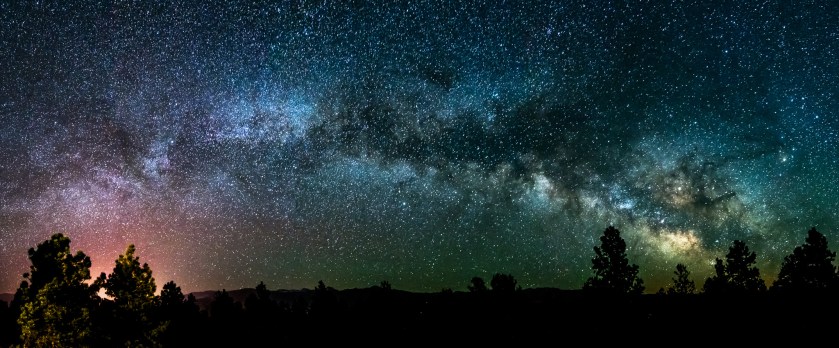
The Milky Way arching over the South San Juan Mountains (May, 2017). The pink glow on the left is from the town of Pagosa Springs, Co. Stitched panorama from 12 individual photos.
First though, the Milky Way. While our home galaxy is visible year round, beginning in March, the Galactic Center, the Milky Way “core” will be visible. This is perhaps the most dramatic and photogenic portion of our galaxy. The first prerequisite for good Milky Way viewing is a relatively dark sky, so we will need to wait until the recent Full Snow Moon wanes. Starting March 8, there will be periods in which the Galactic Center will be above the horizon with no moon interference in the early morning hours. Best viewing should be from March 9 through the 23rd, when the core will be visible in the hours before dawn. On the night of the new moon, March 13, the viewing time will be from about 2:39 until 4:54 AM (the beginning of astronomical dawn). After the switch to daylight savings time on the 14th, this window moves to 3:35 to 5:53 AM, which somehow seems a bit less onerous. The reward for early risers in Pagosa Springs will be a view of the Milky Way arching over the South San Juan Mountains. Spring is the best time of the year to see the full arc of the Milky Way, and in early spring it will be lower in the sky, allowing for better images of the landscape beneath the arc.
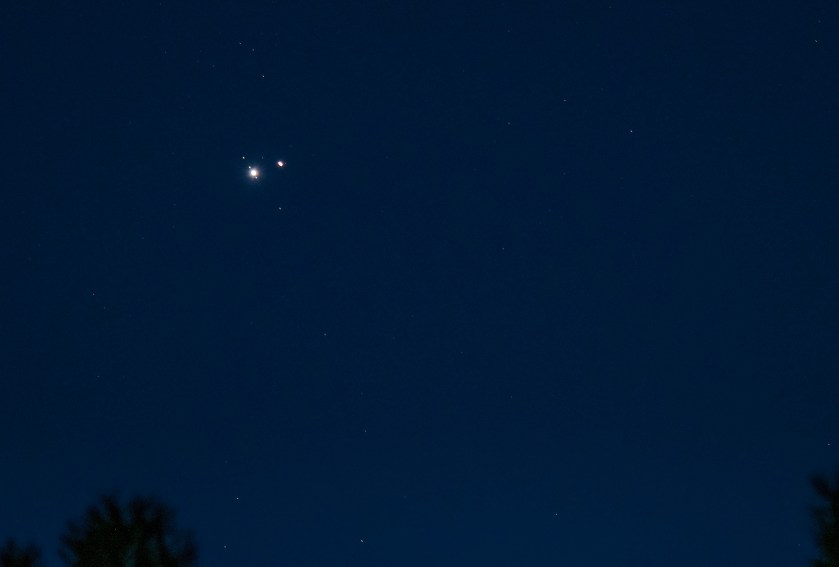
There are other opportunities among the planets, and the stars. In the predawn hours of March 6 (and a few days before and after) is a good opportunity to see Mercury as it will reach its greatest western elongation from the sun. At about 5:25, Mercury will rise in the east and reach about 12° above the horizon before fading in the brightening sky. But it gets better, as Mercury will be within about a degree of the gas giant, Jupiter, and nicely aligned with Saturn as well. By March 9, Mercury will be much closer to the horizon (and more difficult to find), but Jupiter and Saturn will be joined by a young crescent moon. These will be close enough to the horizon to afford good nightscape opportunities.
Jupiter and Saturn at their great conjunction on December 21, 2020. Also visible are Jupiter’s four Galilean moons. Exposure was at 1 second, f/2.8, 150 mm using an Olympus OMD EM1-Mk II (300 mm full frame field of view)
Meanwhile, Mars will be much higher in the sky, but will be quite close to the Pleiades open cluster in the evening sky.
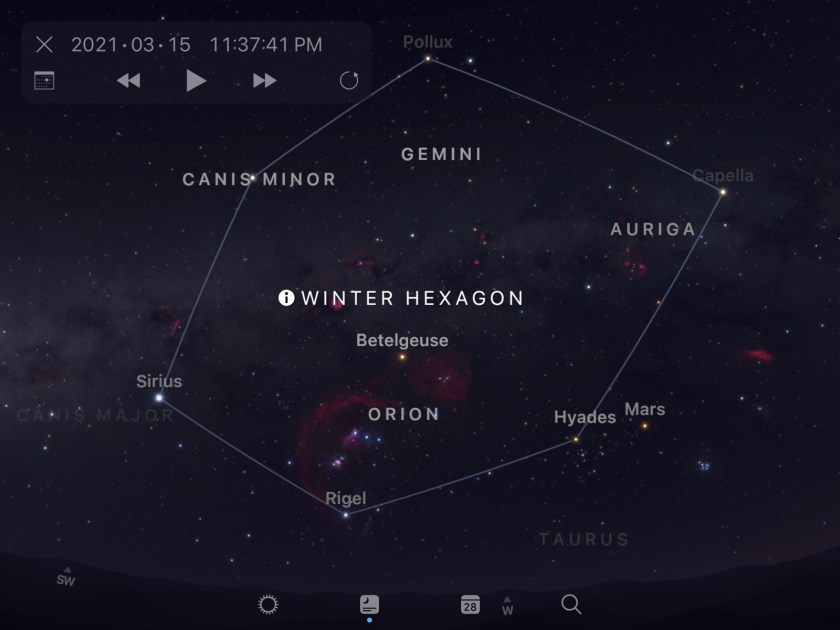
As winter turns to spring, so the winter constellations will gradually disappear. But in the late evenings of March, you can still find Orion and other familiar winter constellations. Look to the west a little before midnight, and Orion, and the bright star Sirius of Canis Major, will be low enough over the horizon to the west-southwest for nightscape photography. You might also look for the Winter Hexagon, featuring Sirius, Rigel , the Hyades, Capella, Pollux and Procyon in Canis Minor.
Orion and the Winter Hexagon, as would be seen looking West-Southwest on March 15, around 11:40 PM, from Pagosa Springs. Screen capture from Sky Guide.
Finally, moonless evenings in early spring are the best time of the year to see zodiacal light in the Northern Hemisphere. Zodiacal light looks like a hazy triangle in the west, as darkness falls. Look for it along the path of the ecliptic. Find out more about zodiacal light at https://earthsky.org/tonight/zodiacal-light-is-glowing-pyramid-in-west-after-dark . By the way, I recommend EarthSky as a great website to keep up with heavenly happenings. To predict the locations of stars and planets, there are several great programs, including the free Stellarium, or apps such as Star Walk or Sky Guide for smart phones.
Beyond the beginnings of “Milky Way season”, March skies have a lot to offer. Good viewing to you!
The Pagosa Springs Photography Club will meet on Feb 10, 2021, at 6:30 pm, via Zoom videoconference. Our topic this month is “Lens Filters in the Digital Age”.
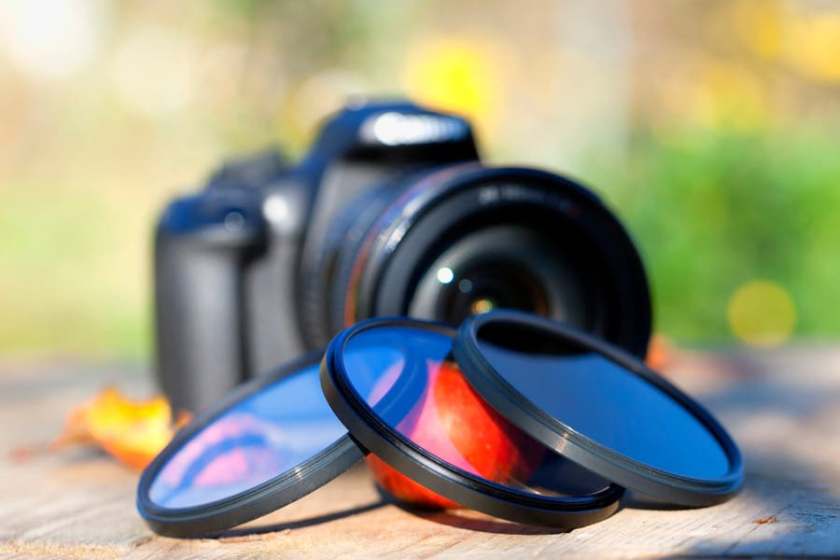
Like wearing sunglasses, putting filters on your camera’s lens can be crucial for taking landscape photos under challenging light conditions. Filters can enhance colors and reduce distracting reflections. They can also protect your lens. For some photographers and videographers, filters may be an essential accessory. For others, they may be of little use, with many of their functions subsumed by the digital darkroom. For many stalwart landscape photographers, using filters to get the best possible image in the field is part of the process and enjoyment of photography. For others, filters may be more of a complication.
So just why would you use lens filters? And when? Which filters are important to have, and which might you skip? How do you choose a good filter? At the February Photography Club meeting, we will address these questions in the presentation “Lens Filters in the Digital Age”.
Club members are encouraged to submit up to five images to share and discuss following the program.
The Photography Club sponsors monthly programs on photographic topics, and field trips to various areas of photographic interest. Longtime photographers and those just starting out are welcome in the Club. Non-members are invited to attend a meeting, and may receive the Zoom link by email to abutler@mac.com. For information on joining the Club, visit our website at https://pagosaspringsphotoclub.org/about/ .

 Pagosa Springs Photography Club